Your first manga can feel surprisingly confusing. An answer appears before the question, or a character seems to change position without moving. Often, the problem is simply the route your eyes are taking. Reading manga involves coordinating panel order, words, and pictures, then working out what happens between one image and the next. A few deliberate habits make that process easier without turning every page into an exercise.
Check the direction before you start
Many manga editions preserve the Japanese right-to-left reading direction, a feature explained in Kodansha’s manga support guide. Start with the book itself: identify its front cover and check for a reading-direction notice. Follow any instructions supplied with that edition. Comics using a manga-influenced visual style do not necessarily share the same direction.
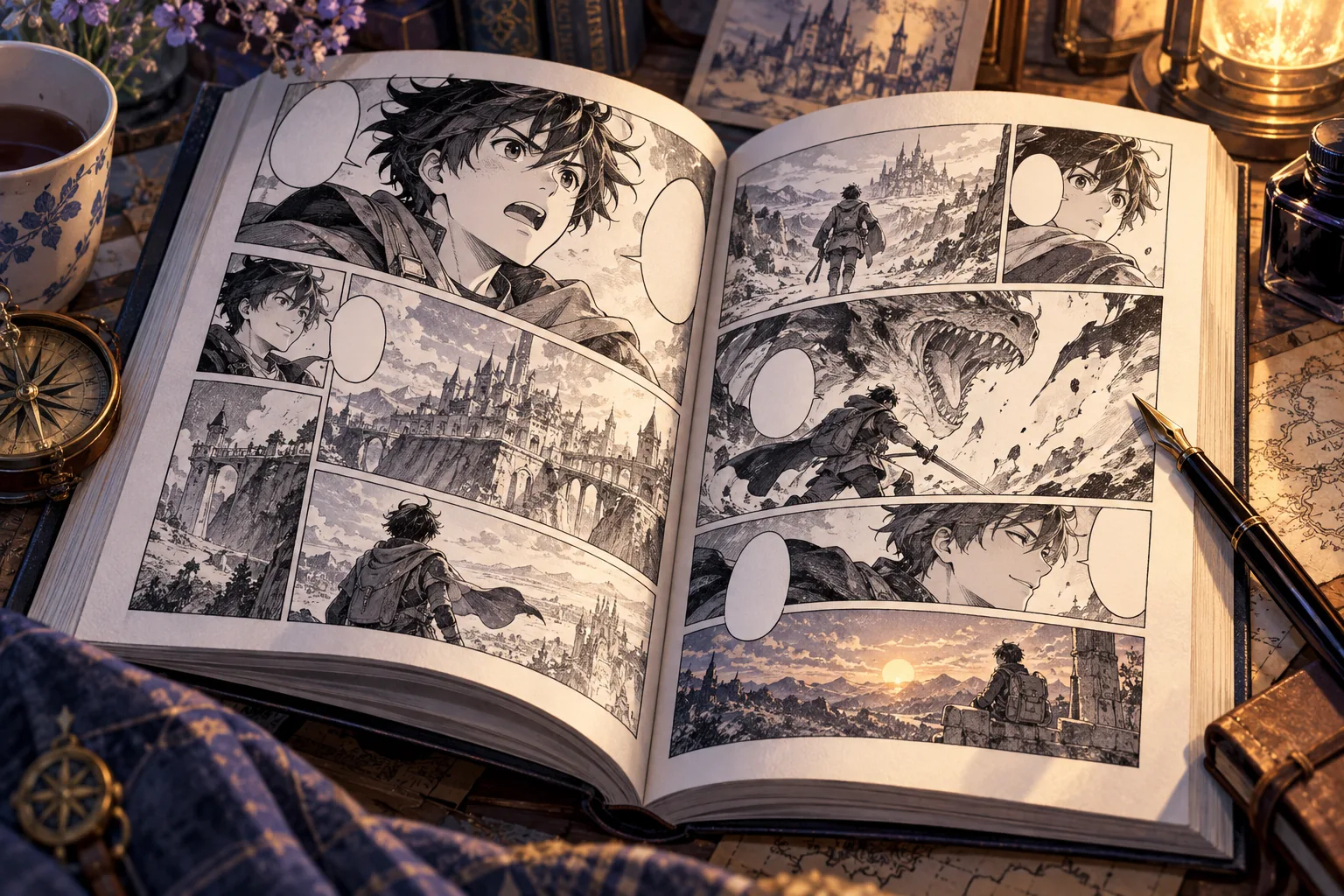
On a page arranged in regular rows, begin at the upper right, work left across that row, then move down. Before reading the dialogue, briefly look at the whole page. This helps you identify where one row ends and the next begins, instead of jumping toward whichever drawing catches your attention first.
Follow groups of panels, not just a rigid grid
Imagine a page created for this example: two small panels sit across the top, with one wide panel underneath. Read the upper-right panel, the upper-left panel, and then the wide panel. Now imagine a tall panel beside several smaller ones. The arrangement requires you to notice which smaller panels form a group before moving into the next part of the page.
The spaces between panels provide useful clues. So do the placement of faces, the direction of movement, and the position of speech bubbles. Combine these signals rather than assuming that every composition follows a perfect grid. If an exchange makes no sense, go back one panel and check another route. Rereading an awkward transition is a normal reading strategy.
Separate bubble order from word order
Inside a panel, speech bubbles often support the overall reading direction, but their height and connections also matter. A bubble’s tail can identify the speaker. A separate rectangular box might supply narration, a location, or an internal voice. Check how that device is used elsewhere in the chapter before treating its shape as a universal code.
English words inside a translated bubble still read from left to right. The change concerns the route between bubbles and panels, not the direction of the sentence itself. Keeping those two levels separate prevents a common beginner’s mistake. If someone speaks from outside the drawing, look back at who was present immediately before the current panel.
Read the picture between the lines
Try not to leap straight from one speech bubble to another. A tightened hand, an empty chair, or a glance toward a doorway can explain why an apparently ordinary answer feels uncomfortable. Describe both channels to yourself: “The character says this, but the picture shows that.” Their relationship may carry more information than either one alone.
Sound effects belong to that visual reading too. Even if you cannot read the original Japanese lettering, its position and relationship to an action can help you understand its role. Look for a translation or a note in your edition. The shape of a sound effect can suggest an impression, but it does not establish its exact meaning.
Keep double-page images together
When an illustration continues across two pages, take in the complete spread before studying individual details. On a screen, check whether the reader offers a two-page mode. The official preview for One Piece, Volume 1, on VIZ includes reader guidance for single-page and double-page views, as well as zoom. Available controls can differ between services and devices.
If you need to zoom in, return to the full page afterward. This restores the positions of characters and the relationship between adjacent panels. Comfortable reading is not about making every drawing as large as possible; it is about moving between detail and context without losing your place.
A short exercise for building confidence
Choose a page from an official preview. First, look through it without reading the words and locate the characters. Next, follow the dialogue in order. Finally, explain in one sentence what changed between the first panel and the last. A character may have learned something, made a decision, or simply noticed another person. Identifying that change means you have connected the visual and verbal information.
Do not worry about achieving a particular reading speed. Some pages reward a quick sweep; others invite you to linger. Once the route feels comfortable, our guide to visual pacing in manga explains what that route can make you feel. If you still need a book to practice with, use our method for choosing your first manga and finding an official edition.