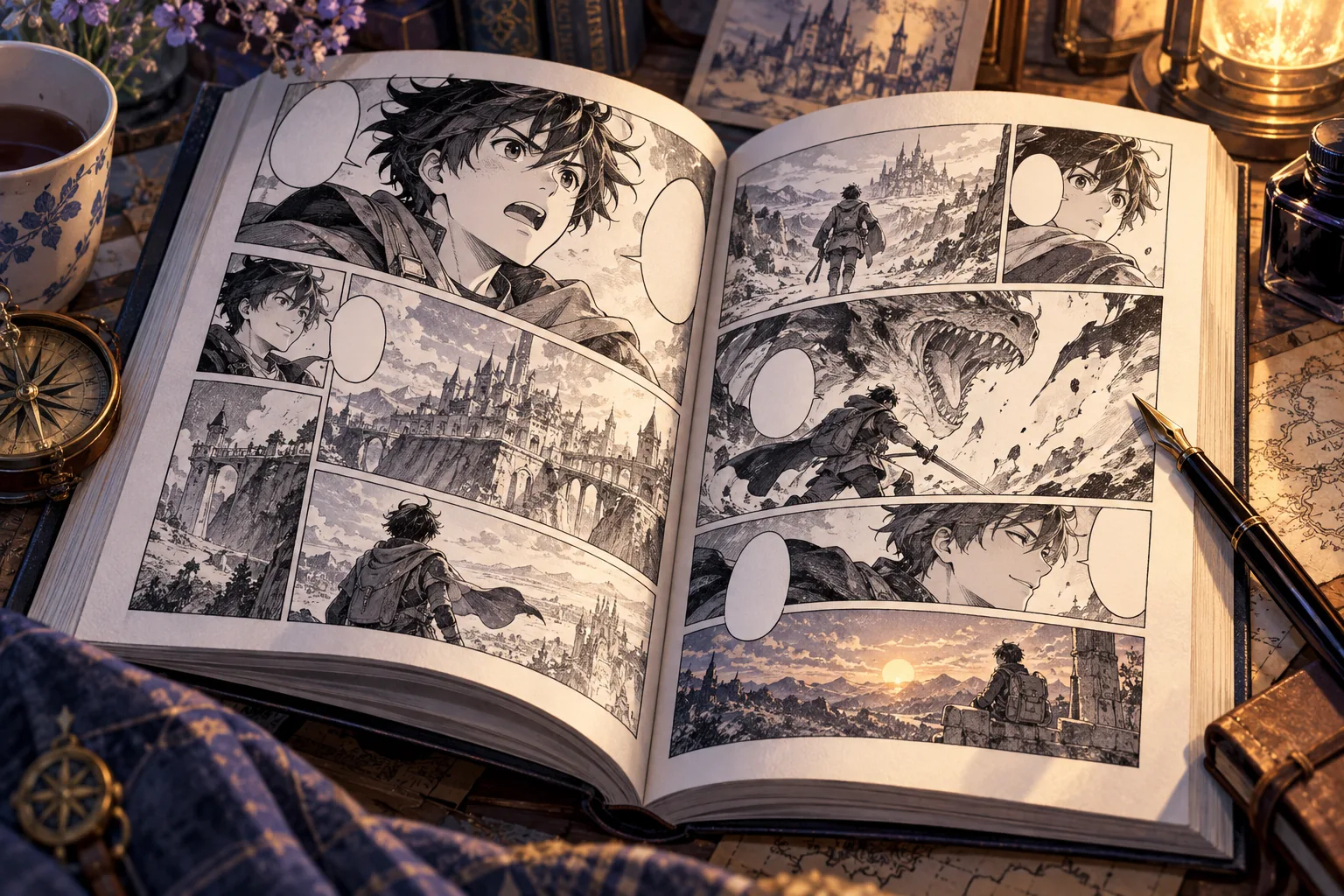
Two pages can depict the same action and produce very different feelings. One carries you forward almost without a pause; another turns a brief moment into an uncomfortable wait. Visual pacing emerges from how a page distributes information and how you move through it. Understanding that process lets you explain why a scene works without reducing your response to “the art is good” or “a lot happens.”
Story time and reading time are different
Start by separating two durations. One belongs to the events: how long a character takes to open a door. The other belongs to the reader: how long you spend examining pictures, reading words, and connecting them. Those durations can diverge. A second of action may occupy several panels, while a journey lasting hours can be handled in one transition.
This is why “more panels means faster pacing” is not a reliable formula. Small consecutive images can create a quick exchange or break down a glance to prolong tension. A large panel does not always produce a long pause either. It may communicate its information immediately. What matters is its content and its relationship to the surrounding images.
An original example: a knock at the door
Imagine a scene created for this exercise. A student is alone in a room, hears three knocks, and finds an envelope beneath the door. In one version, we draw three panels: the student studying, the reaction to the sound, and the envelope on the floor. The sequence communicates the change economically. We do not know who left the envelope, but we reach that question quickly.
In a second version, we use six images: a stopped pencil, a motionless hand, eyes turning toward the door, the strip of light beneath it, the corner of the envelope, and finally the whole envelope. No major new event has been added. The same information has been distributed across a chain of perceptions. That fragmentation invites us to experience the wait with the character.
Now add a long sentence to every panel. Reading will take longer, but the effect changes: attention may shift from uncertainty to verbal thought. Repeat an almost identical image without a meaningful difference, and the pause may start to feel redundant. Extending a scene requires deciding what each additional step gives the reader, not merely adding more boxes.
The eye needs useful landmarks
A composition can guide attention through contrast, faces, gestures, and speech bubbles. In an interview published by MANGA Plus, Naoya Matsumoto explains that he tries to direct the eye naturally toward key elements such as faces and bubbles, avoiding excessively elaborate panel arrangements. That is one creator’s stated approach, not a rule every visual style must follow.
When studying a page, identify what you looked at first and what led you onward. Compare that route with the order in which the story needs to communicate its information. If they align, the reading may feel effortless. If they do not, ask whether the disruption creates a useful effect or simply makes an important action difficult to understand.
A pause can change what a sentence suggests
In another invented example, someone answers “That’s fine” immediately after a proposal. Now place a panel of their hand pushing an object away between the proposal and the reply. The words remain identical, but the second arrangement creates room to suspect hesitation. It does not prove what the character thinks; it offers an interpretation to test against the rest of the scene.
Keep observation and inference separate. “A silent panel appears before the answer” is an observation. “The character is lying” is an inference. A persuasive reading explains the connection and acknowledges when another explanation remains possible. That habit produces better criticism than treating every visual detail as a secret code with one correct solution.
Consider the page turn and the missing action
A reveal placed after a physical page turn can hide information you might otherwise glimpse early. On a screen, the effect depends on how the reader displays the pages. Before interpreting a composition, check whether an image belongs to a two-page spread or stands on its own.
The gaps between panels matter too. A packed suitcase followed by a station lets us supply the journey between them. If the journey itself matters, the comic can choose to show it. Ask what the scene skips and what it slows down to examine. That selection reveals narrative priorities more clearly than simply counting drawings.
A repeatable way to analyze a page
Describe the event, identify where new information arrives, notice where you linger, and imagine removing one panel. If removing it changes the tension, clarity, or meaning, you have located a specific function. Explain that function through visible evidence rather than claiming access to the artist’s private intentions.
For the basic reading route, start with our guide to manga panels. You can then apply these questions alongside our Fullmetal Alchemist introduction, which suggests ways to observe the relationship between action, dialogue, and personal choices.