Your first manga does not need to be the most famous title or the winner of an online poll. It needs to make you curious enough to open it again. A useful choice combines a story you want to explore, a comfortable reading format, and a realistic way to continue. This method turns an overwhelming recommendation list into two or three options you can evaluate for yourself.
Begin with a preference you already understand
Think of a film, novel, or television series you enjoy and explain why. “I liked it” is a start; “I cared about two people learning to trust each other” gives you something to search for. Perhaps you enjoy solving mysteries, exploring an unfamiliar world, following a relationship, or watching someone acquire a skill. Look for that central interest instead of demanding an identical plot.
Next, add a boundary. You might prefer little graphic violence, short conversations, or a story that does not introduce a large cast immediately. The boundary does not have to define your taste forever. It simply narrows this first choice. Consider tone too: a book you want to unwind with calls for different criteria from one you want to find challenging.
Three official previews for three different interests
These are starting points selected from publisher descriptions, not a ranking or a claim that every reader should enjoy them. Each gives the selection method a concrete test. The linked English publisher pages provide previews or a preview entry point; check access on your device and in your region.
For rivalry and teamwork: Haikyu!!
Haruichi Furudate’s Haikyu!!, Volume 1 puts a volleyball rivalry inside a team: Hinata discovers that the opponent he wants to beat will be his teammate. VIZ labels this edition Teen. Try the preview if cooperation under pressure interests you. Your reading test is whether you can follow the players’ immediate goals and whether the rivalry gives you a reason to care about a match. Choose another direction if competitive sport is the part you would prefer to skip.
For a fantasy apprenticeship: Witch Hat Atelier
Kamome Shirahama’s Witch Hat Atelier begins with Coco wanting to become a witch despite believing magic is a gift people must be born with. Kodansha lists a free chapter preview and rates the series 10+. This premise offers a useful test for someone drawn to learning and discovery: does finding out how this world’s magic works make you want to continue? It asks for more interest in an unfamiliar setting than a contemporary sports story does.
For a short book about making art: Look Back
Tatsuki Fujimoto’s Look Back brings two girls together through drawing manga. VIZ lists 144 pages, a Teen Plus rating, and drama, horror and thriller categories. Its compact format offers a smaller book commitment, but those categories are a reason not to mistake brevity for a gentle tone. Use the preview to test whether artistic ambition and the relationship between creators interest you.
The age labels above belong to their respective publishers; they are not one interchangeable rating scale. Check the specific edition’s guidance. Begin with one sample or a library copy where available, then investigate how you could continue in the same language and format before buying several books.
Ask three questions while reading a preview
First, can you follow what is happening? A deliberate mystery may leave information open, but you should still be able to recognize a situation or a reason to care. Second, do you enjoy looking at the pages: the expressions, spaces, character designs, and arrangements? Third, is there something you want to know when the preview ends? Curiosity can be small and specific.
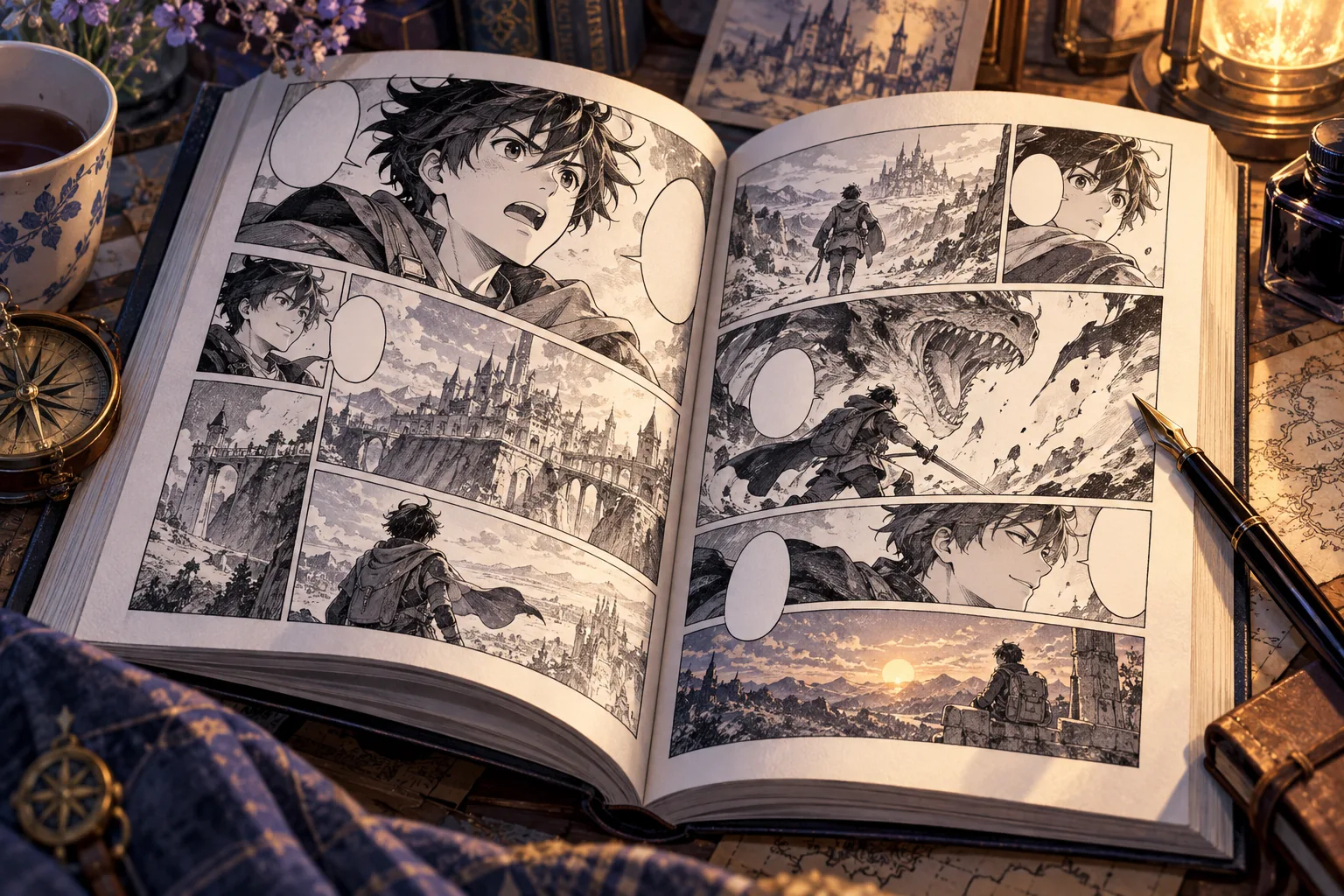
Do not confuse unfamiliar reading direction with lack of interest. If you are still learning the format, spend a few minutes with our guide to reading manga panels and speech bubbles, then return to the sample. You will be better placed to judge the book without blaming it for confusion caused by a new reading habit.
Start with identifiable publishers and services
Look first at the publisher’s website or a reading service it directly identifies. MANGA Plus describes itself as an official Shueisha service and notes that some titles depend on location. Kodansha’s catalog also provides title information and links to previews. These are examples of official sources, not a claim that every manga is available through them.
Check the work’s title, creator, language, and edition. For digital reading, examine what chapters are included and the access conditions. “Free” may refer to a preview rather than an entire series. Catalogs, subscription terms, and territorial permissions can change, so verify the details on the service before building your plan around it.
If you find a title through a search engine or social post, trace it back to the publisher rather than trusting a familiar logo alone. For print, compare a retailer’s listing with the publisher’s ISBN and edition description. For libraries, search the actual catalog rather than assuming that a recommendation means the book is locally available.
Match the format to your routine
On a phone, test whether you can read the lettering without constant zooming. For print, consider weight, dimensions, and storage. A format that makes you physically uncomfortable every few pages can discourage you even when the story interests you. A practical choice makes it easy to pick the book up again.
Set an initial budget for trying a story, not for committing to a complete collection. If a special edition consumes the entire budget, compare another presentation first. Our guide to tankobon, kanzenban, and collected editions explains which differences to investigate without assuming a higher price always buys what you need.
Make the decision after reading
When the trial ends, write down two things that interested you and one thing that made reading difficult. Wanting to understand a character’s next decision is enough reason to continue. Following a title only because everyone recommends it may be a reason to try something else. Stopping does not invalidate the time you spent exploring it.
Keep the title and edition you tried, even if you move on. That small record gives you concrete examples of pacing, tone, and artwork that work for you. Your first manga then becomes a useful reference for the next choice, rather than a test you must pass by loving someone else’s favorite.