If you arrive at Noh expecting frequent scenery changes and conversational dialogue, you may spend the first few minutes looking for the wrong signals. The stage, entrances, voice and controlled movement carry information in ways that deserve time to become visible.
Find the performance space before the action
The Japan Arts Council’s stage guide describes a square main stage and the hashigakari, the bridgeway connecting it to backstage. The bridgeway is also a place of performance, not simply a corridor performers cross before the “real” scene begins. The roof and pillars preserve features of the form’s outdoor-stage history.
When choosing a seat, look at the stage plan rather than only the distance to its center. For your first entrance, watch the performer’s progress through the whole available space. Notice where they pause and whether your attention shifts before they reach the main stage. You do not need to assign a meaning immediately; start by observing the pattern.
A mask does not tell the entire role
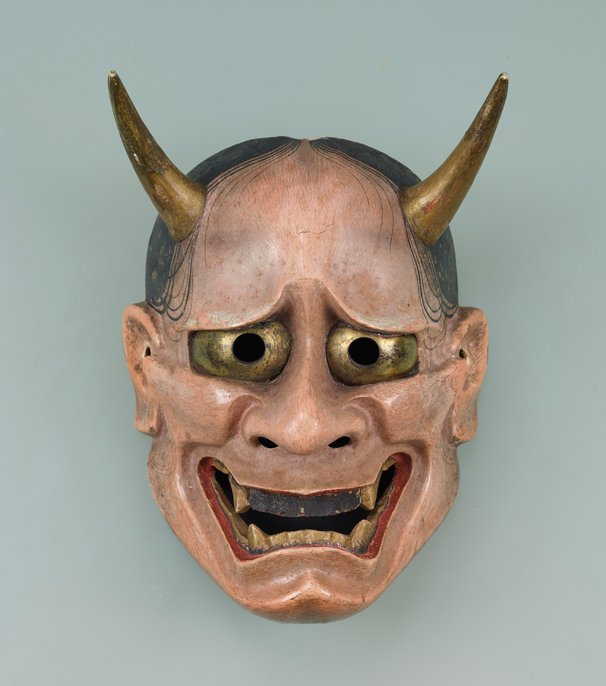
According to the Arts Council’s mask guide, the main character wears a mask in most Noh performances, while Kyogen is principally performed without one. Mask types differ by role and other characteristics, and the choice depends on the play and performance style.
The Hannya mask illustrated here is one specific historical object, not a summary of all Noh masks. Before deciding what a mask “means,” find the play and role in the program. A horned face in a museum case, a mask worn during a performance and a stylized mask in an anime can invite related questions without being interchangeable evidence.
Listen beyond the person at center stage
The Ishikawa Prefectural Noh Theater’s introduction explains that Noh and Kyogen are collectively called Nogaku. It distinguishes Noh’s chant, music and dance from Kyogen’s generally dialogue-oriented comedy. Its performer guide identifies the shite as the principal performer, the waki as the counterpart, and the jiutai as the chorus.
This suggests a useful listening question: where is the story’s voice coming from at this moment? Do not assume that every audible description is ordinary dialogue spoken by the visible character. Follow the relationship between the chorus, the instrumentalists and the central action, then consult the synopsis for what you missed.
Prepare three questions, not a dictionary
Before attending, find the exact play title, the characters and the situation in which they meet. Check whether the performance offers an introductory talk, translated synopsis or another form of support. Availability belongs to the particular venue and program; it should not be inferred from a different theater’s visitor guide.
Bring three manageable questions: who is arriving, what is being remembered or described, and when does the relationship between the performers change? These questions give you something to follow without requiring every line to be understood in advance.
Leave room for uncertainty
Afterward, separate an observation from its interpretation. “The performer stopped on the bridgeway” is an observation. “The stop meant fear” is an interpretation that needs support from the play or performance context. Keeping both in your notes makes a later conversation with a guide or a more experienced viewer much more productive.
Readers interested in how voice and a visible body can work separately may also enjoy our Bunraku guide. It examines a different theatrical system in which narration, music and puppetry are deliberately shared among performers.
Sources & reporting notes
Sources checked 2026-10-27. Dates and availability can change after that check.
- Japan Arts Council: Noh stage structure
- Japan Arts Council: masks in Noh and Kyogen
- Ishikawa Prefectural Noh Theater: fundamentals
Desk research using the linked institutional and publisher sources. Examples and reading exercises are NextPanelTalk analysis; no interview or on-site visit is claimed.