A puppet reaches for a letter. A voice gives the words emotional weight. A musical phrase changes the tension. In Bunraku, these contributions do not need to come from one performer’s body. The visible division of work is part of the art’s expressive possibilities.
Three kinds of performance meet
The Japan Arts Council’s introduction describes Bunraku as a combination of narrative recitation, shamisen music and puppetry. The narrator, or tayu, supplies narration and character speech; the shamisen player responds through music; the puppeteers make the action visible.
This is not simply a speaking doll with accompaniment. A useful starting point is to listen for how the voice changes between narration and dialogue, then watch how the physical gesture relates to it. You may notice that your attention travels between the puppet and the performers rather than remaining fixed on one face.
Why three puppeteers?
The Japan Cultural Expo’s beginner guide explains the common three-person arrangement: the principal puppeteer operates the head and right hand, another manages the left hand, and another the feet. It also notes the convention of black clothing and that the principal puppeteer may show their face.
Knowing that arrangement changes the viewing task. Instead of trying to pretend the operators do not exist, notice how separate movements become one intention. For example, when a hand rises, does the head follow first, simultaneously or afterward? A small difference in that order can change how you read attention or hesitation. This is a suggested observation, not a universal rule for a particular gesture.
| Contribution | Listen or look for | Question to take away |
|---|---|---|
| Narrator | Changes between description and character speech | Whose perspective did you hear? |
| Shamisen | Rhythm, attack and pauses around the voice | When did the musical tension change? |
| Puppeteers | The relationship between gaze, hands and body | Which small action made the intention readable? |
Do not reduce the repertoire to children’s entertainment
The Arts Council describes complex stories involving relationships, separation and loss, alongside humor and dance. The presence of puppets does not establish a young audience or a light subject. Read the program’s synopsis and content information for the work you are choosing, particularly if attending with children.
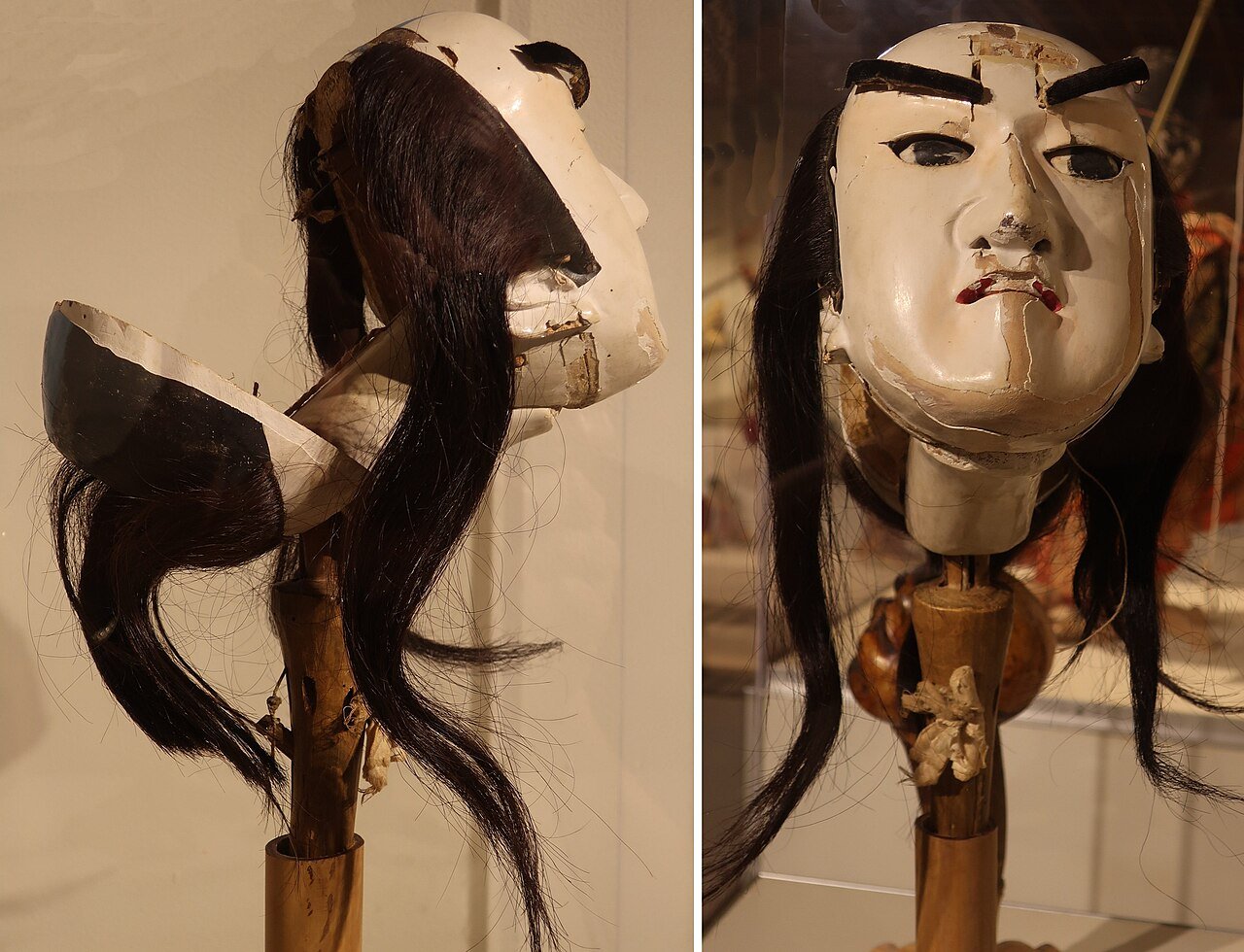
Nor should a historical puppet in a display case be treated as a complete performance. The object pictured on this page shows a head and its control structure. It can help you think about construction, but it cannot convey the timing of voice, music and manipulation that occurs on stage.
Prepare for the particular program
Confirm the venue, date, part or act, running time and available language support through the current organizer’s listing. An introductory resource from a previous year can explain the art well while giving outdated ticket information. For a first visit, a synopsis read beforehand can be more useful than trying to decode every line as it happens.
If you use a caption or audio service, alternate between it and the stage. Choose one short stretch to follow primarily through movement, then use the explanation to recover the narrative. You can return to the same scene later through an authorized recording if one is available.
A good question after the performance is not merely whether the puppet “looked real.” Ask when its action became understandable and which contribution made that happen. That question connects naturally with animation’s shared production roles, while respecting that live puppetry and a recorded animated scene are different forms.
Sources & reporting notes
Sources checked 2026-10-27. Dates and availability can change after that check.
Desk research using the linked institutional and publisher sources. Examples and reading exercises are NextPanelTalk analysis; no interview or on-site visit is claimed.