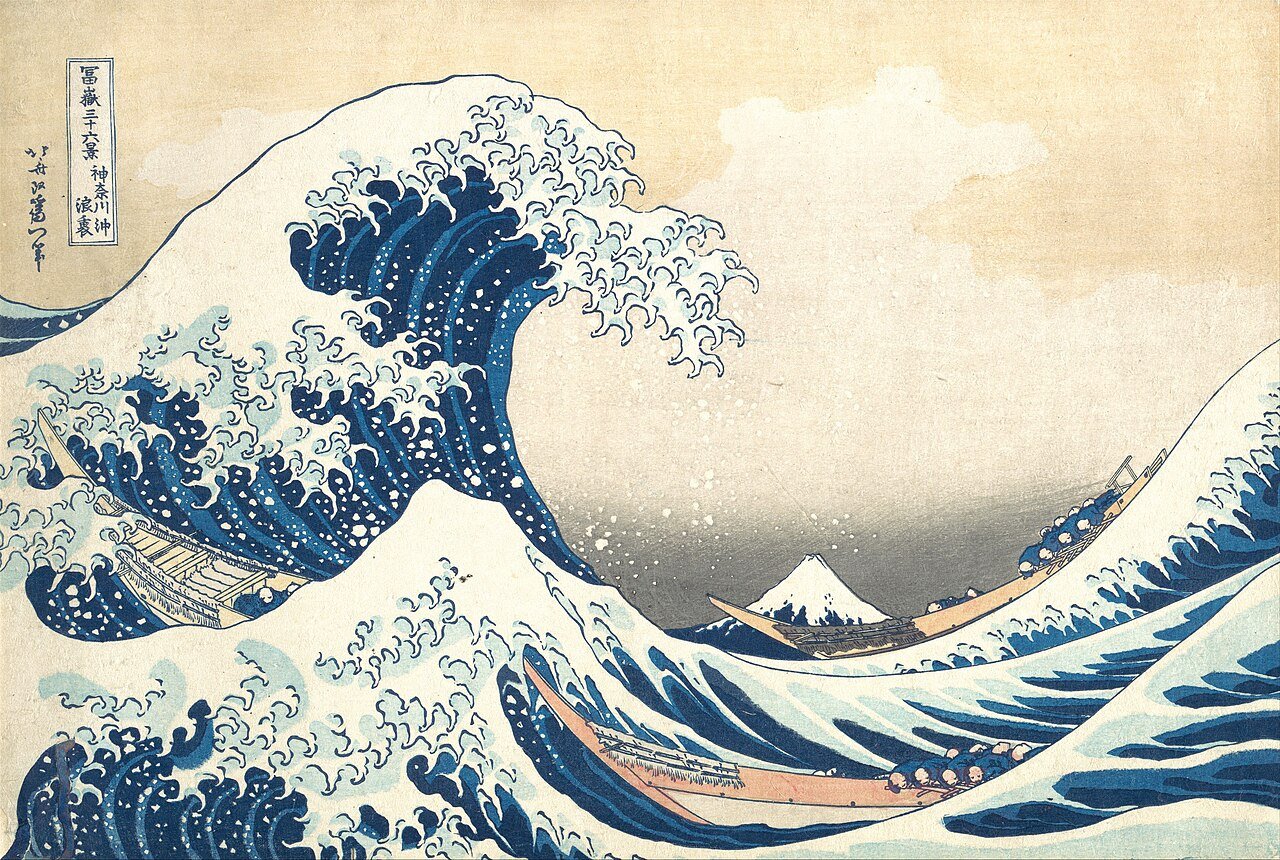
A familiar image can make its production seem deceptively simple: Hokusai drew the Great Wave, and the picture reached us. A woodblock print, however, is the result of a process involving several kinds of work. Looking at that process helps explain why a design and one particular printed sheet are not quite the same object.
Four contributions to a finished print
The Metropolitan Museum of Art’s account of ukiyo-e describes collaboration among a designer, engraver, printer and publisher. The publisher organized a commercial project; the designer supplied the image; carving translated it into blocks; printing transferred ink onto paper. The artist’s recognizable name does not erase those other contributions.
The Asian Art Museum emphasizes the publisher’s role in choosing subjects, coordinating production and distribution. This offers a useful way to approach popular imagery: ask who expected an audience for it and how it was made reproducible, as well as who designed it.
Read the object label in layers
| Label detail | What it helps establish | What it does not settle alone |
|---|---|---|
| Artist or designer | The credited creator of the design | The identity of everyone involved in production |
| Medium | Whether you are looking at a woodblock print, painting or another object | The object’s entire publication history |
| Date | The institution’s dating of the work or impression | That every reproduction online depicts the same sheet |
| Accession or object number | The specific museum record | A universal identifier for all impressions of the design |
For example, the Met’s Great Wave record identifies Hokusai’s design, a date around 1830–32, the medium as a woodblock print in ink and color on paper, and object number JP1847. Those details are more useful for a comparison than a search-result caption saying only “Japanese wave painting.” The illustration on this page is separately credited to its own file source.
Follow a line, then a field of color
The Birmingham Museum of Art’s printing guide explains the relief process: the image is carved into wood, ink is applied, and paper receives the impression; multiple colors involve separate blocks. Its terminology includes baren, the rubbing tool used to transfer the image.
Try looking at one contour in an enlarged museum image. Follow it around a sleeve or boat. Then inspect where a color field meets that line. Finally, zoom back out. Does the edge you noticed affect how the whole image reads? This is an observation exercise, not a way to authenticate a print or judge its value.
Compare images without inventing a history
If two online versions look different, record the source and object number for each. Differences in scans, lighting, cropping or display can affect what you see; a screen comparison alone cannot explain an object’s condition or printing history. Avoid turning “this blue looks lighter” into “this must be an earlier impression” without specialist evidence.
For manga readers, the useful connection is collaboration and reproduction, rather than a claim that all modern comics descend directly from one print. Both invite attention to how an image reaches an audience through a material and editorial process. Our Hokusai Manga guide considers a related problem: a familiar word can conceal a different historical kind of publication.
Sources & reporting notes
Sources checked 2026-10-27. Dates and availability can change after that check.
- The Met: Woodblock Prints in the Ukiyo-e Style
- Asian Art Museum: the ukiyo-e printing process
- Birmingham Museum of Art: printing guide
- The Met: Great Wave object record JP1847
Desk research using the linked institutional and publisher sources. Examples and reading exercises are NextPanelTalk analysis; no interview or on-site visit is claimed.