A supernatural character in anime often arrives with a confident description: a name, a power and a rule for defeating it. Folklore is less tidy. Similar names can appear in different local accounts, and a modern story can select or transform details for its own purposes. Treating a character profile as a complete traditional belief produces unreliable explanations.
The International Research Center for Japanese Studies, Nichibunken, offers a useful alternative: follow the record, place and source before deciding what a figure “always” means.
Start with an account, not a universal monster profile
Nichibunken’s yokai database introduction describes bibliographic information on mysterious phenomena and yokai reported in folklore research. Its English overview explains that the database brings together records from sources such as researchers’ reports, essays and oral accounts. It is a record of reported traditions and experiences, not a scientific confirmation of supernatural beings.
For any entry, note the place, date, original source and how the account was recorded. A detail documented in one region should not automatically become a rule attributed to every community in Japan.
Keep three kinds of evidence separate
| Source | What it can establish | What it cannot establish alone |
|---|---|---|
| Folklore account | A recorded telling associated with a source and context | That everyone shared the same belief |
| Historical image | How an artist or book represented a figure | That the image documents an actual encounter |
| Anime or manga character | The rules and appearance used in that fictional work | An unchanged, universal ancient tradition |
Nichibunken also maintains a yokai image database. Its separate visual focus is valuable because a picture and a written account may organize their subject differently. An appealing illustration should not silently replace the evidence for a claim about local belief.
A practical research path from a character name
Suppose an umbrella-like creature in an anime prompts a search for older images of animated objects. Here is one result you can identify precisely: the Metropolitan Museum of Art’s The Night Parade of One Hundred Demons by Tachibana Gadō. Its catalog supplies a completed source note:
| Field | What the museum record identifies |
|---|---|
| Artist | Tachibana Gadō |
| Date | 1892 |
| Object | A handscroll in ink and color on paper |
| Collection identifier | The Metropolitan Museum of Art, 2022.432.26 |
The museum’s description identifies umbrellas and other everyday objects among the creatures. That supports a limited historical comparison: an imagined object becoming animate is present in this documented artwork. It does not establish the source of a particular anime character.
A defensible note would say: “The Met catalogs an 1892 scroll by Tachibana Gadō whose procession includes animated household objects.” A stronger sentence—“this anime character was copied from Gadō”—would need evidence connecting the production to that object. A resemblance supplies a research question, not that missing connection.
To continue, record the modern character’s name, work and exact scene beside the museum identifier. Compare one feature, such as the object’s shape or its action. Keep what the anime explicitly states in a separate column from what the museum describes. You can then explain a similarity without inventing a creator’s intention or a universal rule for every yokai.
How to read the image accompanying this article
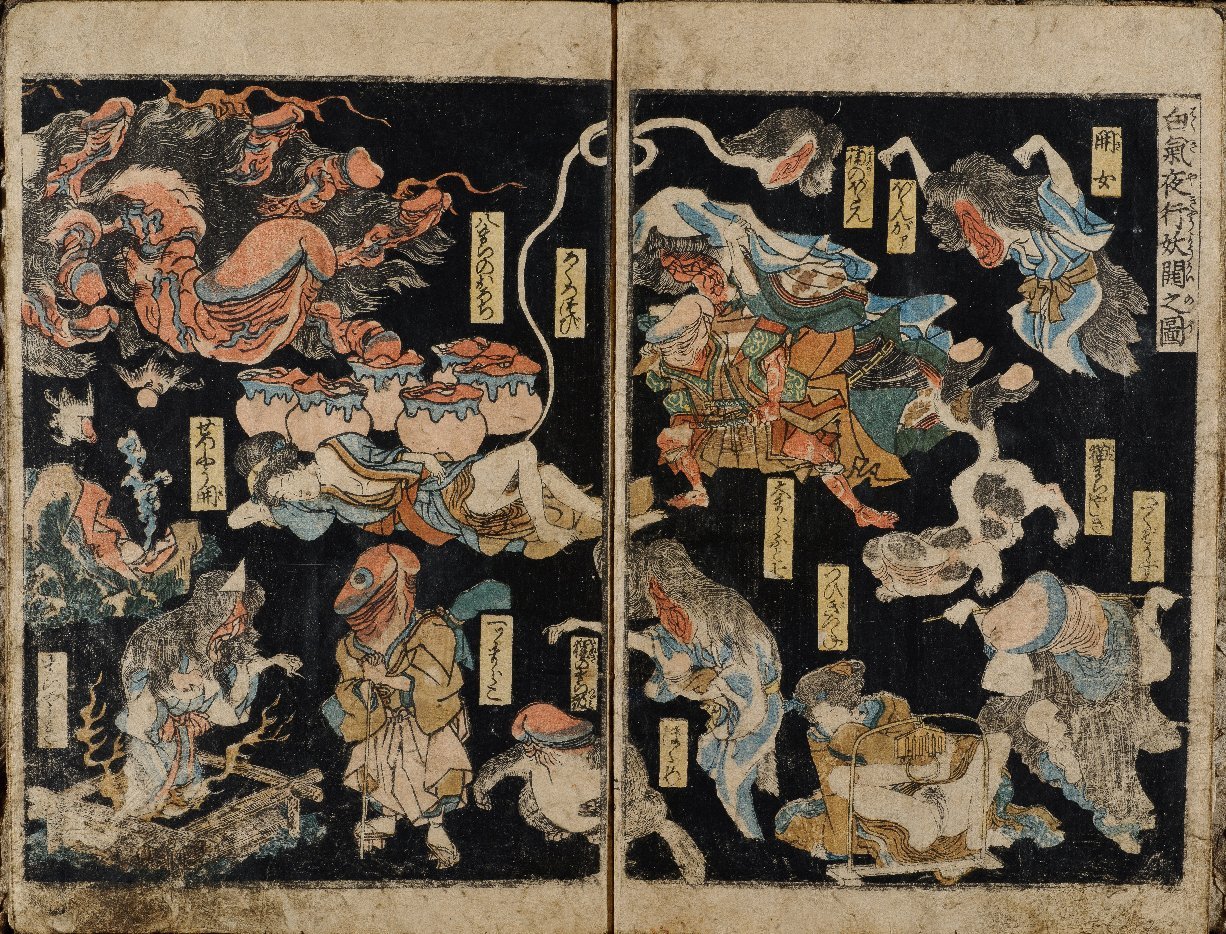
The image accompanying this article is Kunisada’s 1825 night-parade artwork, credited in the caption to the Honolulu Museum of Art. It is a different object from Gadō’s 1892 scroll discussed above. A shared English title is not enough to identify an image; keep the artist, date and collection with it. The caption and image-credit record remain attached to the Kunisada reproduction.
This distinction also prevents a common editorial shortcut: using an invented fantasy image as though it supplied historical information. We use credited historical material and identify modern interpretation in the text.
Sources & reporting notes
Sources checked 2026-11-10. Dates and availability can change after that check.
- Nichibunken: scope and historical-content notice for the yokai database
- Nichibunken: English overview of the folklore database and record fields
- Nichibunken: English overview of the yokai image database
- The Met: Tachibana Gadō, The Night Parade of One Hundred Demons (1892), object 2022.432.26
Sources checked November 10, 2026. The worked example uses The Met’s catalog record; the image accompanying this article is a different, separately credited Kunisada work. Nichibunken warns that historical materials may contain language or assumptions inappropriate by current standards. The article distinguishes documented representations from claims about a modern creator’s influences.