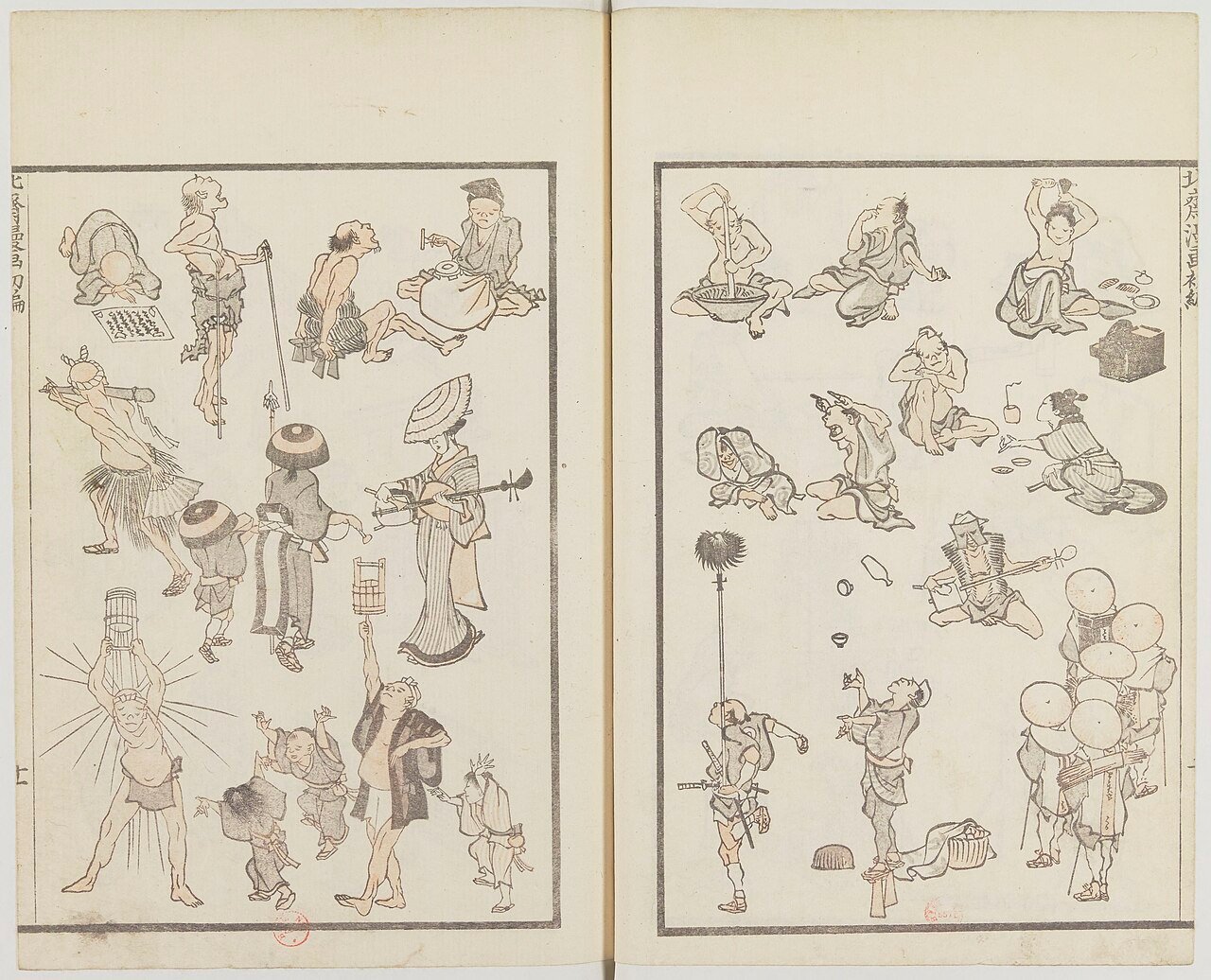
The title Hokusai Manga can create an expectation of a story told through modern comic panels. Looking at the books with that expectation makes it easy to miss what the pages actually offer: arrangements of figures, actions, creatures, objects and places that invite comparison rather than necessarily continuing one plot.
The Metropolitan Museum of Art’s collection record classifies its set as illustrated books and describes woodblock printing with ink and colour on paper. The British Museum’s Hokusai resources place Hokusai’s Sketches among the drawing manuals he illustrated. That is a more precise starting point than calling the books an early season of a familiar modern format.
Separate the historical book from today’s category
The shared title is worth investigating, but it does not establish a single uninterrupted publishing form. A modern volume may organize a continuing narrative, while a drawing book may gather a range of examples useful for observation, imitation or visual enjoyment.
Before drawing a historical conclusion, distinguish three questions: what a word meant in a particular context, what the object physically contains and how later publishers or readers describe it. Similar terminology can connect objects without making them identical.
A close-looking exercise
Open a digitized spread through a museum or library record. First identify whether the figures share a space. Then ask whether a later figure changes the situation created by an earlier one. If the answer is unclear, do not impose a panel-by-panel story just because you expected a comic.
Next compare poses or repeated forms. What changes between two bodies, gestures or viewpoints? You can learn from the comparison without asserting that the figures represent the same character at different moments.
Finally, look at the page as a printed object. Notice where one cluster of marks ends and another begins, how much empty paper separates groups and whether captions alter your interpretation. These are observations to make from the chosen spread, not a fixed description of every Hokusai volume.
Why the edition record matters
An online image can lose its connection to its book. Use the library or museum record to identify the title, volume, material, date and collection. Distinguish an original design from the date of the particular printing or digital reproduction you are viewing.
The historical opening accompanying this article comes from a named digitized source recorded on our image credits page. Its catalog metadata should not be treated as proof that every Hokusai Manga volume appeared in the same year. The Met’s record describes a fifteen-volume series, and bibliographic details require attention to the specific item.
A useful comparison with modern manga
Compare the spread with a clearly sequential page from a publisher’s legal preview. In the latter, identify the order that reveals a decision or an event. In the former, investigate whether selection, grouping or variety is doing more work than sequence.
This comparison makes the differences visible without needing to declare one format more advanced. Our manga reading guide explains how sequence can direct a reader; the historical book is an opportunity to see where that approach is useful and where it needs adjusting.
Sources & reporting notes
Sources checked 2026-10-20. Dates and availability can change after that check.
This article is a source-based introduction and looking exercise. It does not claim direct examination of the original books. Institutional catalog records and their current research notes are the references for individual objects.