An unmoving stare can hold a scene’s tension. A very brief gesture can turn silence into a joke. Discussions of anime sometimes flatten those choices into a simple claim: more frames mean better animation. The problem is that a playback measurement cannot describe drawing, timing, movement, and storytelling all at once.
Limited animation uses movement and changes of drawing selectively. A production may hold a pose, animate only part of a body, or reuse a cycle. These descriptions identify techniques; they do not, on their own, establish the quality of a finished scene. The useful question is what a scene accomplishes with its choices.
Playback frames and new drawings are different things
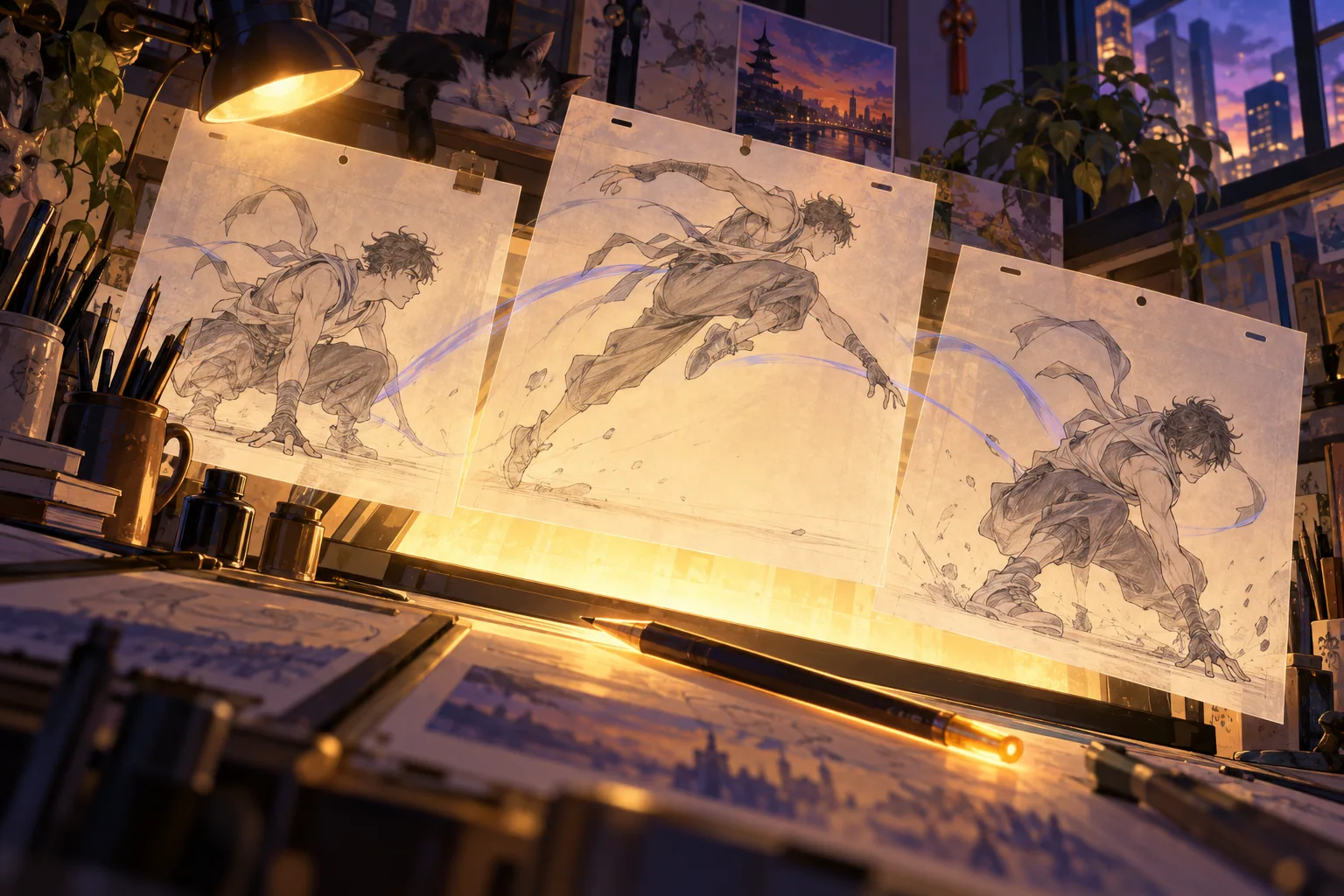
A video can play at a constant frame rate while repeating one drawing across multiple consecutive frames. Within a shot, different elements can also change at different rates. The frame rate of a file therefore does not tell you how many distinct drawings it contains or how much work went into making them.
Movement also depends on how changes are distributed through time and space. For a primary teaching resource, Norman McLaren and Grant Munro’s Animated Motion: Part 1, catalogued by the National Film Board of Canada, examines tempo within a series on animation technique. It offers a way into studying motion, rather than a ranking system for anime.
A pose communicates before it moves
Imagine two drawn characters waiting for a bus. One rests their weight on one leg with lowered shoulders. The other leans toward the road, hands tense. Even without movement, those poses can suggest patience and urgency. Continuously animating every part of their bodies is unnecessary to establish the difference.
If the second character suddenly taps a foot, the gesture stands out because the rest remains relatively still. Selective movement creates a hierarchy of attention. A small change can be expressive when it arrives in the right place and at the right moment.
The same technique can also fail. If the held pose does not communicate the intended feeling, the scene may seem lifeless. This is why naming a technique cannot settle an evaluation: execution, purpose, and context still matter.
A pause prepares a contrast
A fast movement feels different after a wait than it does within nonstop activity. Stillness may prepare an impact, extend an awkward moment, or give us time to recognize an expression. It need not be an empty interval between important events. It can be the event that matters.
Consider an invented comic scene in which someone tries to appear relaxed, waits several seconds, and then drops an object. The wait establishes an expectation; the fall breaks it. Shortening the pause or smoothing every transition could weaken the joke even if the result contained more visible motion.
To examine the timing, identify the preparation, the change, and the reaction. Ask which phase supplies the meaning. A spectacular action with an unreadable reaction may communicate less than a modest movement whose consequence is immediately clear.
The whole shot contributes
Energy also comes from framing, distances between elements, and editing. A moving background, a sound entering the scene, or a change in scale can direct our attention while a character holds a pose. Distinguishing these tools from character animation makes a description more precise.
Sound deserves separate attention. Picture a still room in complete silence, then imagine the same composition accompanied by heavy rain. The drawing has not changed, but the perceived atmosphere may have. That does not make the drawing unimportant; it shows that a scene coordinates several expressive tools.
How to make a useful criticism
Instead of saying only that a scene “does not move,” identify the difficulty. Perhaps an action is hard to follow because its trajectory is unclear. Perhaps the poses do not respond to a changing conversation. Perhaps the cuts prevent you from understanding the space. Those are different problems with different possible solutions.
Avoid inferring budget, individual effort, or working conditions from a few finished seconds. The result does not document every stage of its production. Those claims need evidence about the process. Visual observation supports an analysis of what appears on screen, not an invented account of how it got there.
Try applying these questions to one short sequence rather than an entire series. Our guide to pacing in adaptation offers a similar approach to duration. Our spoiler-free introduction to Mob Psycho 100 considers how contrast supports tone. In each case, the goal is to explain what the chosen movement expresses, not to turn a technical number into a verdict.